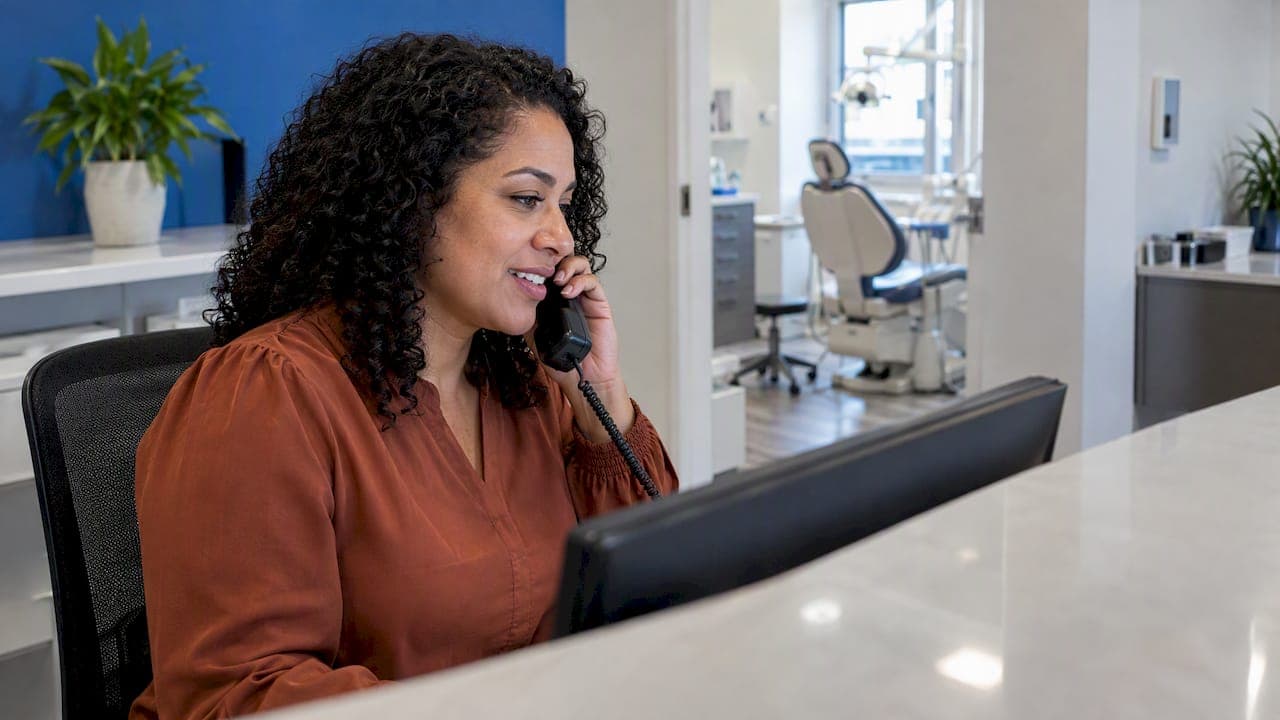
The best dental appointment reminders go out in a short series: a first notice well ahead of the visit, a confirmation a few days before, and a last nudge the same day. They use the channel each patient prefers, and they contain only the basics: who, when, where and how to confirm or reschedule. Automation handles the sending, so your front desk team handles the conversations that need a human.
This guide covers what to send, when to send it, which channel to pick, what the American Dental Association (ADA) says about message content, and what you need to know about consent rules for automated calls and texts. It also covers how to measure whether your reminders are working.
TL;DR
- Use a three-step cadence: an early reminder, a confirmation three to five days out, and a same-day message. The ADA says many practices confirm at least one day ahead and should pick the timing that fits their patients.
- Match the channel to the patient. Phone, text and email all work, and one small pediatric dental trial found voice reminders beat texts.
- Keep messages minimal: practice name, phone number, date and time. Never mention treatment details on a voicemail.
- Automated calls and texts fall under the TCPA (a federal law on automated calls and texts). Treatment-only messages with an easy opt-out are treated differently from marketing messages.
- Reminders help, but they do not fix every reason patients miss visits. Track no-shows and confirmations to see what works in your office.
Table of Contents
- Why reminders matter to a dental practice
- What automated reminders actually are
- When to send dental appointment reminders
- Calls, texts or email: choosing the channel
- What a dental reminder should say
- HIPAA, TCPA and consent: the rules in plain English
- Automating confirmations, cancellations and rescheduling
- Reminders do not fix every missed visit
- How to measure whether your reminders work
- Where a custom AI bot fits
- Perspective
- Put reminders to work in your practice
- FAQ
- Sources
Why reminders matter to a dental practice
An empty chair is hard to refill on short notice. A 2016 U.S. review in Community Dentistry and Oral Epidemiology describes broken dental appointments as interrupting continuity of care, wasting resources, disrupting workflow and reducing access for other patients. That last point matters: the slot one patient misses is a slot another patient could have used.
Reminders attack the simplest cause, which is forgetting. The same review is careful to note that reminder calls alone do not address every reason people skip visits, including cost, transportation, fear and trouble understanding why a visit matters. So think of reminders as the floor of a good attendance system, not the whole building. We come back to the rest below.
What automated reminders actually are
An automated reminder is a message your office does not type or dial by hand. Software pulls the appointment from your schedule and sends a call, text or email at a set time. Some tools only send. Others let the patient reply "C" to confirm or ask to reschedule, and then update the schedule.
Three terms come up when you shop for these tools:
- Practice management software: the program that holds your schedule and patient records. Reminders are only as accurate as the schedule they read from.
- Two-way messaging: the patient can reply, and the system understands the answer, rather than just receiving a message.
- AI voice or chat bot: a program that can hold a short conversation by phone or on your website, answering a question or offering open times instead of playing a recording.
When you compare options, ask two plain questions. Does it read your real schedule? And what happens when a patient replies with something unexpected, like "can I come Thursday instead?"
When to send dental appointment reminders
There is no single correct moment, but the evidence points to a pattern.
The ADA says many practices confirm appointments at least one day before treatment and recommends choosing the method and timeframe that work best for the patient base. Its resource for providers who treat Medicaid patients goes further, recommending text or phone reminders plus an extra morning-of reminder, and regular checks that contact information is current.

A 2019 AAPC report analyzing 20 million appointments from one patient-communication vendor found the highest confirmation rate, 79%, for a first reminder sent three weeks before the visit. It also described a three-step cadence as operationally useful: a second reminder three to five days before and a final one about three hours before. That data comes from medical appointments in general and from a single vendor's customers, so treat it as a starting point to test, not a law.
A cadence you can start with
| Step | Timing | Purpose | Example channel |
|---|---|---|---|
| 1 | Two to three weeks before (or at booking for short-notice visits) | Put the visit on the patient's calendar | Text or email |
| 2 | Three to five days before | Ask for a confirmation and give an easy way to reschedule | Text, or a call for patients who prefer voice |
| 3 | Morning of, or a few hours before | Prevent plain forgetfulness | Text |
Two practical notes. First, recall visits scheduled six months out need a different first step: a message at booking, then the cadence above as the date approaches. Second, if a patient has not confirmed by step 2, that is your signal to have a person call, while there is still time to offer the slot to someone else.
Calls, texts or email: choosing the channel
The ADA describes reminders as telephone calls, email or smartphone texts, notes that many practices combine them, and advises recording each patient's preferred contact method. That last piece of advice is the one most offices skip, and it is the cheapest improvement available.
Do not assume texting always wins. In a 2011 randomized University of Washington study at a pediatric dental clinic, voice reminders produced an 8.2% no-show rate versus 17.7% for text reminders. The authors concluded text was not necessarily preferable in that setting and suggested studying patient-selected messaging. The population was parents of children, so results may differ in your practice, but it is a good reason to ask patients what they prefer instead of picking for them.
For younger adults the picture leans digital. A July 2026 Virginia Dental Journal article by Michaela Mishoe Raoufi, published through the ADA's commons, notes that convenience and digital-first channels are critical to whether Gen Z patients engage with scheduling at all.
A workable rule:
- Text for most working-age patients and anyone who books online.
- Phone call for older patients, parents, and anyone who does not answer texts.
- Email for the early notice and for forms or instructions that do not fit in a text.
What a dental reminder should say
Short, polite and specific beats clever. The ADA's guidance for voicemail is to give your name, the practice name and phone number, and the appointment date and time, and to not discuss treatment. The same discipline works for texts, since a phone screen can be seen by anyone nearby.
A good reminder has five parts:
- The practice name, so the patient knows who is writing.
- The date, time and location.
- One clear action: reply to confirm, or call or tap to reschedule.
- The office phone number.
- A friendly tone, with no pressure or scolding.
Here is a template you can adapt:
Hi Maria, this is Lakeside Dental. You have an appointment on Tuesday, March 4 at 9:30 AM. Reply C to confirm or call us at (555) 555-0100 to reschedule. We look forward to seeing you.
That sample uses a made-up practice and number. Notice what it leaves out: the procedure, the balance owed and any promotion. Keeping a reminder purely about the appointment matters for legal reasons, covered next.
HIPAA, TCPA and consent: the rules in plain English
Two U.S. laws shape automated reminders. HIPAA is the federal health privacy law. TCPA is the Telephone Consumer Protection Act, which limits automated calls and texts, especially to mobile phones. The ADA's guidance on phoning patients is the clearest dental-specific source, and it is dated 2021, so check the ADA page for updates before you finalize your setup.
The key points from the ADA:
- HIPAA-covered practices do not need prior written consent for healthcare calls or texts when messages are treatment-only, contain no marketing or financial content, and meet the other listed requirements. Those include an easy opt-out that is honored right away.
- To lower TCPA risk, the ADA advises getting patient consent before the first contact, confirming contact details are current, training staff to spot reassigned phone numbers, and honoring every request to stop.
In practice, that means:
- Collect each patient's preferred phone and consent at intake, and write down how they want to be contacted.
- Keep reminders free of promotions, balance reminders and recall marketing. Send those separately, under their own consent.
- Make "reply STOP" work every time, and update your records the same day.
- Re-verify numbers at each visit. A number that now belongs to a stranger is a real risk.
- Ask your software vendor whether it will sign a business associate agreement (a contract that obligates a vendor handling patient data to protect it under HIPAA).
This is a compliance overview, not legal advice. For your own practice, talk with a healthcare attorney or your state dental association.
Automating confirmations, cancellations and rescheduling
Sending the reminder is the easy half. The value comes from what happens after the patient replies. A well-built flow handles four outcomes:
- Confirms: the schedule is marked confirmed and nobody needs to touch it.
- Wants to reschedule: the patient is offered open times, or the request goes to a staff member with the patient's preferred windows.
- Cancels: the slot is flagged right away so your team can fill it from a waitlist.
- Does not answer: a second attempt on another channel, then a task for a person.
The weak point in most setups is the third outcome. A cancellation that arrives by text at 8 p.m. does nothing for you if nobody sees it until morning. Decide in advance who owns the cancellation list and how quickly they act.
Reminders do not fix every missed visit
The University of Michigan-led review cited earlier makes a point worth keeping on the wall of your front office: missed appointments often reflect social, structural, psychological and health-literacy barriers, so generic calls are not enough and interventions should be tailored.
What tailoring looks like in a dental office:
- A patient who skips because of cost gets a conversation about payment options at booking, not a third reminder.
- A patient anxious about a procedure gets a short check-in message from your team before the visit.
- A patient with transportation trouble gets offered first-of-day or last-of-day slots and a way to tell you early.
Automated reminders free your team's time for exactly these conversations. That is the real return: not just fewer reminder calls dialed by hand, but more attention for the patients who need it.
How to measure whether your reminders work
Pick a few numbers and check them monthly:
- No-show rate: missed appointments divided by scheduled appointments.
- Confirmation rate: share of patients who confirm before the visit.
- Late cancellations: cancellations inside 24 hours, which are the costly ones.
- Fill rate: how many cancelled slots you refilled.
- Reply rate by channel: which channel patients actually answer.
Change one thing at a time, such as the timing of the second reminder or the channel for patients over 65, and give it a few weeks before judging. Record your baseline before you start, so you are comparing against your own office and not an industry figure.
Where a custom AI bot fits
Most dental reminder tools are built around one task: send a message. A custom AI bot can also take the next step of the conversation. At PaulBots, we build bots configured around how each business actually runs, and several of them touch the reminder cycle.
Our Check-In Bot is built for appointment reminders and customer check-ins. Our Follow-Up Bot handles the follow-through after a missed or unconfirmed visit. Our Service Bot answers calls and common questions and books appointments, which matters when a patient calls back after hours to reschedule.
Perspective
We talk to a lot of owners who describe the same pattern. Missed calls and forgotten follow-ups are not a marketing problem, they are a time problem. The front desk is checking in a patient, answering a billing question and holding the phone all at once.
Our view is that a reminder should never be a standalone blast. It should be part of a conversation: the patient confirms, asks a question or reschedules, and the answer lands in your workflow without anyone retyping it. That is why we build bots to match each business's own operations instead of handing owners a generic tool and a manual.
We also think owners should not have to learn AI or hire a developer to get there. Our approach is to configure the bot for the task, test it with you, and keep supporting it. We cannot promise any particular drop in no-shows, because every practice and patient base is different. What we can do is take repeat messaging off your team's plate so they can spend that time on patients.
Paul Graves
Put reminders to work in your practice
If your team spends part of every day calling to confirm visits or chasing unanswered texts, a bot configured for your schedule and your patients can take over that routine. We set it up for you, so you do not need technical skills.

See the bot types we offer on our pricing page, or contact us to describe your office and your current reminder process. Pricing for each bot is discussed with you directly.
FAQ
Do dentists send reminders?
Most do. The ADA notes that practices commonly use phone calls, email or text, often in combination, and often confirm at least a day ahead. Sending a reminder is standard practice, and the method is usually up to the office.
How do you politely remind a patient about an appointment?
Name your practice, state the date and time, and give one simple way to confirm or reschedule. Keep the tone warm and leave out treatment details. For voicemail, the ADA suggests giving your name, the practice name and number, and the appointment date and time only.
Are text appointment reminders HIPAA compliant?
They can be, when the text is limited to the appointment basics and your vendor handles patient data properly. The ADA also says treatment-only messages with an easy, honored opt-out can qualify for the TCPA exception to prior written consent. Confirm the details for your practice with a healthcare attorney.
What is the best time to send appointment reminders?
Use more than one. A common pattern is an early notice, a confirmation three to five days ahead, and a same-day message. The ADA says to choose the timing that fits your patients, so test and compare your own no-show numbers.
Are automated reminder calls better than texts?
Not always. One University of Washington pediatric dental trial found voice reminders had a lower no-show rate than texts. Ask patients which they prefer and record it.
Sources
- Toward a better understanding of dental appointment-keeping (Community Dentistry and Oral Epidemiology, 2016)
- Appointment Confirmations, American Dental Association
- Medicaid Provider Resources: Strategies to Reduce Missed Appointments, American Dental Association
- Optimal Time to Remind Patients of Appointments, AAPC
- Assessing the effectiveness of text messages as appointment reminders (PubMed, 2011)
- How Dental Practices Can Better Market to Gen Z Audiences, Virginia Dental Journal
- Minimizing Cancelled Appointments, American Dental Association
- Follow the Rules When Phoning Patients, American Dental Association